
The town Zittau
In the tri-border region Germany - Republic Poland - Czech Republic the town Zittau is located with currently about 24.984 inhabitants (31.12.2006) at the south-east corner of Saxony, about 120 kilometers distanced from Saxony’s capital Dresden. The capital of the Czech Republic, Prague, is closer then the German capital Berlin. A little river named "Mandau" flows thought the town. It leads into the "Lausitzer Neisse" which seperates the town area of Zittau in the east to Poland. The "Zittauer Gebirge" ("Zittauer Mountains") with villages like "Oybin" and "Jonsdorf" borders on the south of the town. In the south-east the village "Olberdorf" is located with a lake ("Olbersdorfer See") and "Bertsdorf", in the nord-west is "Mittelherwigsdorf" and in the north is "Ostritz". The barock-town Zittau offers many restaurated buildings and places of interest although Zittau suffered on the economical breakdown after the first and II. World War, the socialistic-planned economy in the GDR and the political change in 1989. Today Zittau is a town with a lot of little shops, enterprises, cafès, restaurants, historical buildings, fountains, an international High-school-institute and a college with approx. 35000 students from 31 countries. Interesting for tourists is the geographic position at the Zittauer Mountains, a relaxation-area near the lake "Olbersdorfer See", the "Zittauer Schmalspurbahn" (a small steam-operated train driving to the mountains since 1890) and the short ways to Poland and the Czech Republic over 2 border crossings for cars and pedestrians in the town, a transition by train of the DB (German Federal Railway) and an additional transition for cyclists and pedestrian in "Hartau".
Places of interest
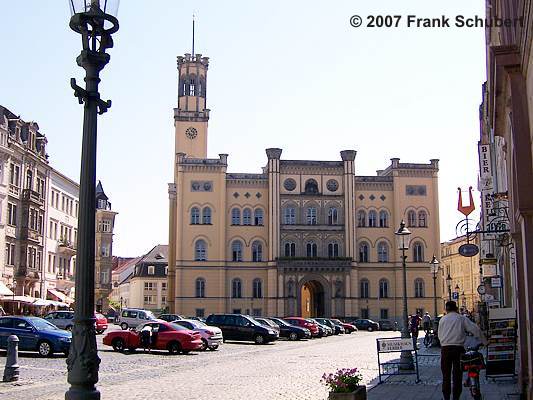 The townhall of Zittau was built under direction of Carl August Schramm in neorenaissance-style in 1840-1845.
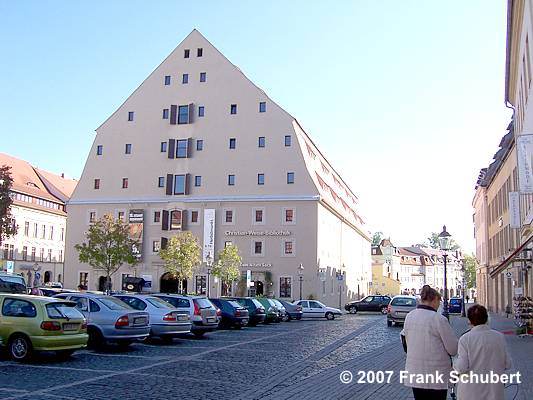 The
"Marsstall" ("royal stables") or "Salzhaus" ("salt-house") on the new part
of town was built in 1511 and used as armoury, stable and granary. In the
year 1730, a mansard-roof with five further grounds was put on it. Since the
19. century it was used as a administration building, store-room of museums
and town-archive. It was redeveloped in 1997.
The
"Marsstall" ("royal stables") or "Salzhaus" ("salt-house") on the new part
of town was built in 1511 and used as armoury, stable and granary. In the
year 1730, a mansard-roof with five further grounds was put on it. Since the
19. century it was used as a administration building, store-room of museums
and town-archive. It was redeveloped in 1997.
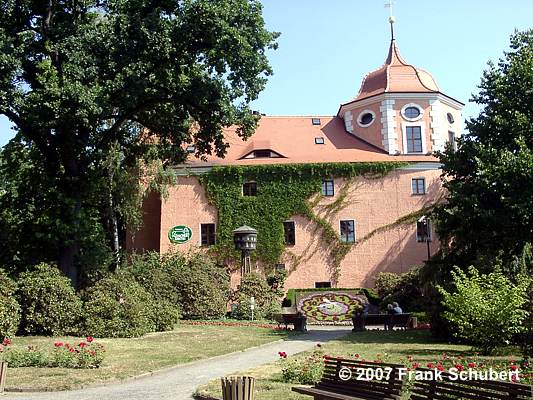 At the "Karl-Liebknecht-Ring" you can find the"Fleischerbastei" ("butcher-bastion"). It was built in 1633 as a part of former fortification of the town. after the redevelopment 1998 is is used as a restaurant, the flower-clock can be found here too.
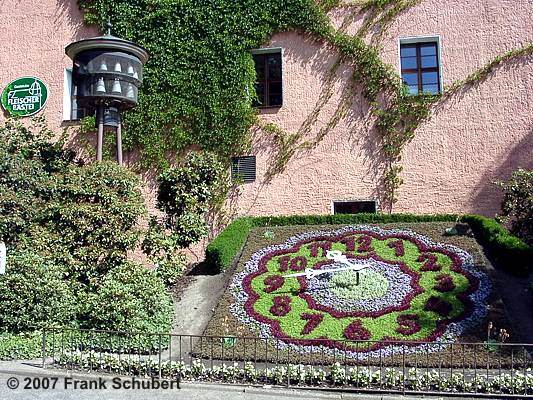 The "Blumenuhr" ("flower-clock") was created 1907 on plans of the former park-inspector Graboski. The clock-face consists of approximately 4800 flowers and is planted annually for three times. At every full time, a folk-song is been played by the "Meissner-porcelain"-chimes (donated 1966 from Zittau´s craftpersons).
 The Dornspachhaus is a renaissance-building of 1553.
In the ground-floor of the building at the market, restored in 1998, a historic restaurant can be found today.
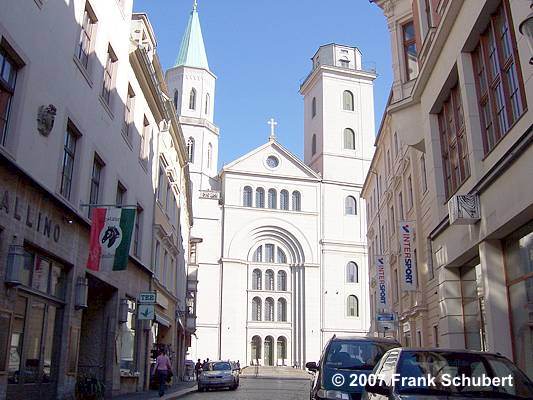 The
origin gothic hall-church "Johanniskirche" ("St. Johns Church") from 1291
was destroyed in a cityfire 1757. The placing of the foundation stone for
the rebuilding was at the 23. July 1766. It was built until 1770, and then
it came to several construction-stops because of money-lack and rips in the
building. Finally the building was inaugurated in 1837.
The
origin gothic hall-church "Johanniskirche" ("St. Johns Church") from 1291
was destroyed in a cityfire 1757. The placing of the foundation stone for
the rebuilding was at the 23. July 1766. It was built until 1770, and then
it came to several construction-stops because of money-lack and rips in the
building. Finally the building was inaugurated in 1837.
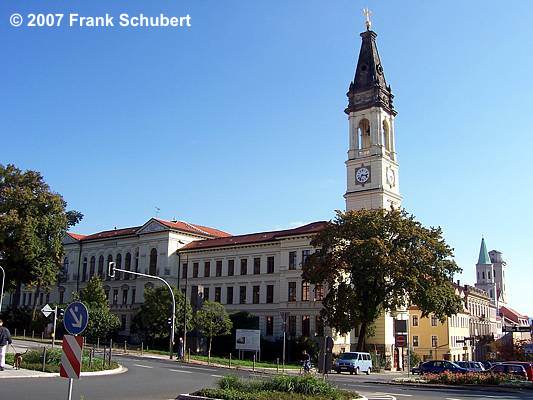 The "Johanneum" was built at the "Theater-Ring" in late-classical-style from 1869 to 1871. It lodged the urban school-institution at first, later the extended secondary school (since 1960) and the "Christian Weise"-grammar school today.
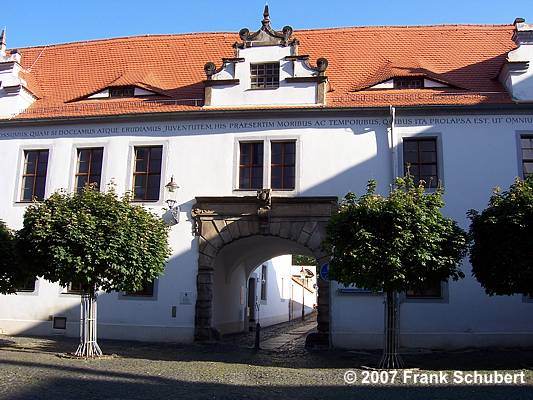 The "Alte Gymnasium" ("old grammar school") at the "Johanniskirchplatz" was opened in 1586 and is one of the first German grammar schools at all. It got its present-day looking though a rebuild in 1602 as the little alley was bridged.
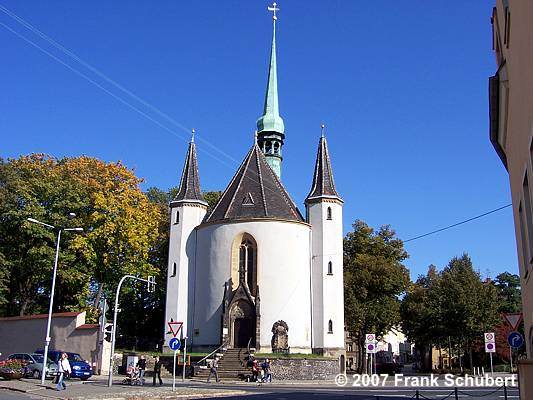 The "Weberkirche" ("weaver-church") at the "Innere Weberstrasse" was built from 1488 to 1508. Between 1713/18 and 1889 further rebuildings took place, so the entrances vanished at the North- and South-side and got an entrance to the West
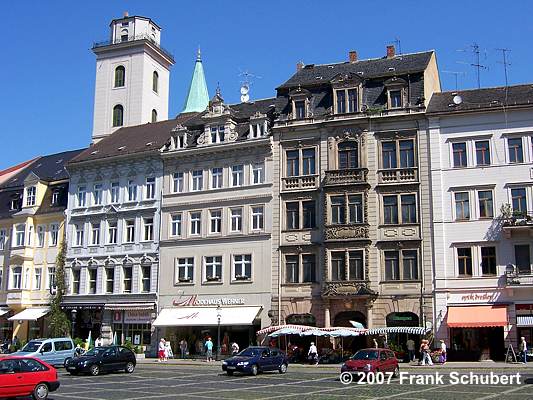 A view of some restored historical buildings at the market place.
Zittau - The town of fountains
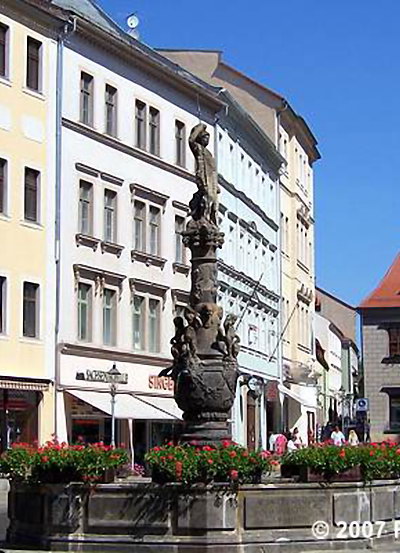 The "Roland"-fountain was build in 1585 and is the oldest of Zittau´s
fountains
The "Roland"-fountain was build in 1585 and is the oldest of Zittau´s
fountains
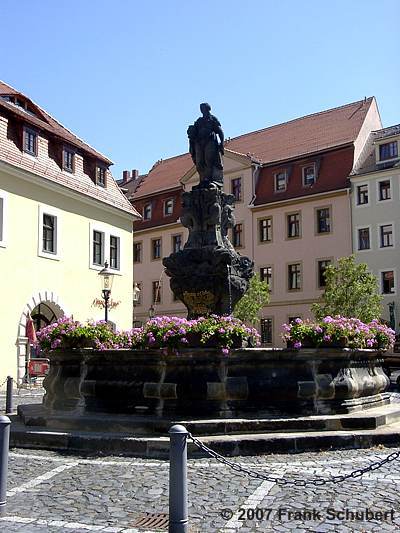 "Samaritan"-fountain (1679)
 "Hercules"-fountain (1708)
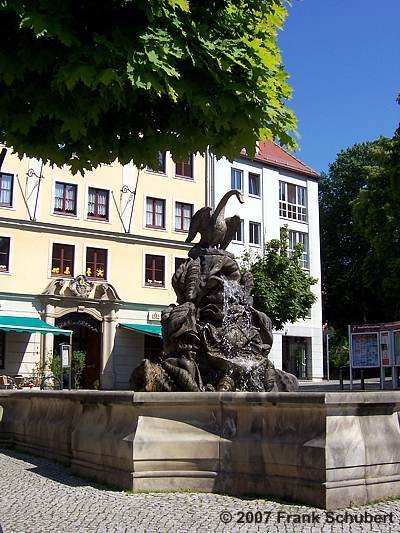 "Swan"-fountain (1710)
A short historical review |
|
|
Year
|
Event
|
| 1238 | The name "Zittau" is mentioned in a document of the cloister "Marienthal" for the first time. |
| 1255 | The king of Bohemia, Ottokar II., rides around the town and establishes the limits for the city-wall and awards Zittau the town-law. |
| 1346 | The cities Bautzen, Goerlitz, Loebau, Kamenz, Luban (Lauban) and Zittau join together in the "Sechsstädtebund" ("six cities-trades"). |
| 1348 | Emperor Karl IV., gives Zittau to Duke Rudolf of Saxony, Zittau ransoms 10 years later again. |
| 1354 | Starts of constructions works of the 2. Zittauer town hall. |
| 1359/1422 | Disastrous fires rage in town. |
| 1424 | Zittau surrendered against superiority of Hussites |
| 1555/59/99 | The pestilence demands the town big casualties. |
| 1586 | Zittau`s grammar school is inauguration. |
| 1631 | Zittau is involved into the thirty-years-war. |
| 1635 | The "Oberlausitz" ("upper lusitia") comes to Saxony by the "Prager Frieden" ("Prague peace"). |
| 1757 | Last great city-fire throught fire of Austrian troops in the seven-years-war. |
| 1845 | Inauguration of new town hall. |
| 1854 | Completion of "Neiße-Viadukts" (a high and long railway bridge) on way from Zittau to Reichenberg. |
| 1859 | The main-train-station is handed over. |
| 1873 | Zittau`s town-bath is opened. |
| 1890 | First operation of the narrow-gauge railway to mountains of "Zittauer Gebirge". |
| 1945 | After the WWII new regional-borders were established. All areas east from the river "Neisse" felt to Poland, also Zittau´s local-part called "Grossporitsch" (Porajow). |
| 1969 | Engineer-college is founded. |
| 1988 | 750-years jubilee of the first documentary mention. |
| 1989 | Demonstartions of thousend of citizens against the government´s exisiting power-structures in Berlin. |
| 1990 | The GDR joins the FGR at the 3. October 1990. |
| 1992 | Foundation of the University of Applied Sciences Zittau/ Goerlitz. |
| 1996 | The town Zittau turns into a big district capital. |
| 2004 | The joining of the Polish and Czech neighbors to the EU at the 1. May is celebrated together at the "Dreilanderpunkt" ("three-nations-point"). |
| 2005 | Jubilee-year "750 years of the town Zittau". |